
Advanced POEM procedure for smooth swallowing and better quality of life.
Peroral Endoscopic Myotomy, commonly abbreviated as POEM, is a cutting-edge, minimally invasive procedure designed to treat esophageal motility disorders, particularly achalasia. Introduced in 2008 by Dr. Haruhiro Inoue in Japan, POEM revolutionized how we approach conditions that once required open or laparoscopic surgery.
This technique has become a preferred alternative due to its precision, reduced recovery time, and effectiveness, offering hope to patients suffering from chronic swallowing issues and related complications.
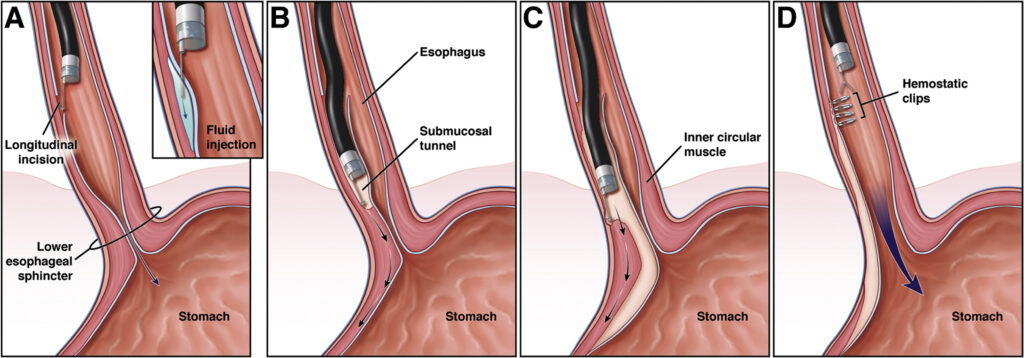
1. Initial Assessment:
The patient undergoes endoscopy and esophageal manometry to confirm achalasia and determine suitability for POEM. These tests evaluate the esophagus’s structure and muscle function.
2. Preparation:
POEM is performed under general anesthesia. The mouth and throat are prepared to allow safe insertion of the endoscope.
3. Endoscope Insertion:
A flexible endoscope is gently inserted through the mouth and advanced into the esophagus, providing a clear view for the surgeon.
4. Mucosal Incision:
A small cut is made in the esophagus’s inner lining (mucosa) to access the submucosal space, the layer between the mucosa and muscle.
5. Submucosal Tunnel Creation:
A tunnel is carefully created along the esophagus to reach the lower esophageal sphincter, allowing safe access for the myotomy.
6. Myotomy:
The circular muscle fibers of the lower esophageal sphincter are precisely cut to relieve tightness and improve swallowing.
7. Tunnel Closure:
The mucosal incision is closed with clips or sutures to ensure proper healing and prevent complications.
8. Post-Procedure Care:
The patient is monitored for any complications and given guidance on pain management, diet, and recovery.
9. Follow-up:
Regular check-ups are scheduled to monitor swallowing, assess healing, and manage any long-term issues such as reflux.
Achalasia: POEM works well for all three types—Type I (weak, dilated esophagus), Type II (trapped food with esophageal pressurization), and Type III (spastic contractions). By cutting the inner esophageal muscles, POEM helps food pass easily into the stomach.
Diffuse Esophageal Spasm (DES): Characterized by irregular, uncoordinated contractions, DES can cause severe chest pain and difficulty swallowing. POEM relaxes the spastic muscles, restoring smoother swallowing.
Jackhammer Esophagus: In this condition, the esophagus contracts too strongly and frequently, leading to intense chest pain and dysphagia. POEM targets these overactive segments, reducing symptoms effectively.
Other Rare Spastic Disorders: POEM can also treat less common motility problems, such as nutcracker esophagus or hypertensive LES, by precisely cutting spastic muscles to relieve pain and improve swallowing.
While POEM is generally a safe and minimally invasive procedure, there are a few potential risks that patients should be aware of:
Air Leakage into the Chest (Pneumomediastinum): During the procedure, some air may escape into the space around the lungs. This is usually temporary and often resolves on its own without serious problems.
Bleeding or Infection: As with any surgical procedure, there is a small risk of bleeding or infection. These complications are uncommon and can typically be treated promptly with standard medical care.
Gastroesophageal Reflux Disease (GERD): Some patients may experience acid reflux after the procedure. This can usually be controlled effectively with medications and lifestyle adjustments.
Overall: Most complications associated with POEM are minor and resolve quickly. The procedure has a strong safety record, and serious issues are rare when performed by an experienced surgeon.
Clinical data from multicenter trials show:
94% symptom relief at 2 years post-procedure
Durability similar to or better than Heller myotomy
High patient satisfaction due to faster healing
Many patients report long-lasting relief from dysphagia, regurgitation, and chest discomfort.